Tips for Safely Running in
the Dark by
James
Raia - for Active.com
Running before sunrise and after dusk is
discouraged by national running advocacy organizations, but since daytime
training isn't always an option as the shorter days of year approach, runners
need to take extra precautions.
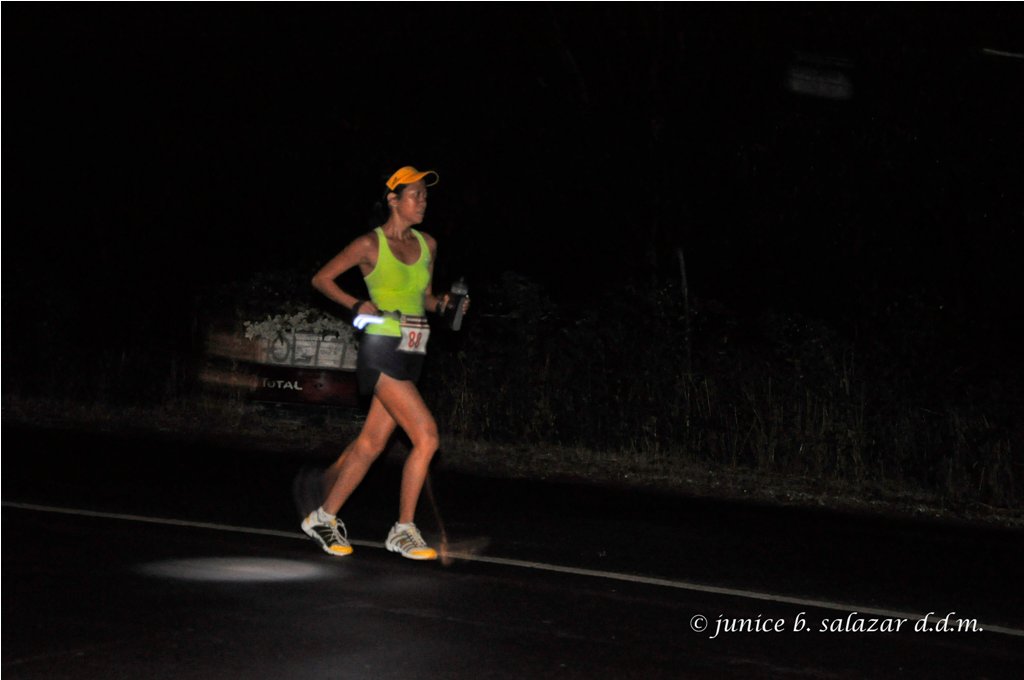 Fred Kaiser and Pam Cantelmi, two veteran
long-distance runners in Sacramento, Calif., know winter's running hazards all
too well. Fred Kaiser and Pam Cantelmi, two veteran
long-distance runners in Sacramento, Calif., know winter's running hazards all
too well.
While training after work on a rainy
December night several years ago, the duo was struck at a suburban intersection
by a pick-up truck.
Details of the accident were bizarre, with
the vehicle driver and the two runners unsure of exactly what happened.
Kaiser was only slightly injured, but
Cantelmi suffered head and shoulder injuries and was hospitalized. Fortunately,
both runners were able to resume their exercise routines.
The accident was particularly ironic since
both runners were wearing reflective gear. Other runners -- some wearing
reflective vests, some not -- have been less fortunate.
"I had on a reflective vest, I had a
flashing light around my waist and I was carrying a flashlight," recalled
Kaiser, a real estate attorney who has completed many marathons and
ultramarathons since his accident.
"Sometimes, it just doesn't matter. Drivers
aren't looking for runners and sometimes they're not going to see you,
regardless of what you're wearing. You have to look for them. It can be pretty
scary out there."
Although it's no guarantee of safety,
wearing reflective gear is the top priority. Dozens of options -- vests,
flashlights, blinking shoes, reflective strips, arm bands, etc. -- are
available at most running apparel stories and through mail-order catalogs.
Wearing reflective gear on your arms and
legs, rather than on your trunk, is also important since drivers are more
likely to see the reflective or glowing light when it's in motion.
"We're out there with only the thickness of
our T-shirts to protect us," said Kaiser. "There's no body armor involved in
the sport of running. The car is going to win."
But night running not only presents
potential vision problems for drivers, runners' vision is poorer at night, too.
Potholes, branches, wire fences and slippery leaves are all difficult to see,
particularly as dusk becomes nighttime.
"The two key things about running at night
are to see and to be seen," said Susan Kalish, former executive director of the
American Running Association (ARA) in Bethesda, Md. You need to know where
you're going, what you'll find there, and whether drivers can see you
coming."
Runners training at night should also adhere
to other common sense guidelines. Consider:
- Run against traffic. It's easier
to avoid traffic if you can see it.
- Don't wear dark colors at night.
White running attire is the easiest to see at night, but orange and yellow are
also appropriate. Black, brown, dark blue or green are not recommended.
- Run behind vehicles at
intersections. Even if a car or truck has stopped at a stop sign, there's
no guarantee the driver has seen you.
- Don't wear headphones. Wearing
headphones diminishes a runner's ability to hear a car horn, a voice or a
potential attacker.
- Wear a billed cap and clear
glasses. The bill of a cap will hit an unseen tree branch or another
obstacle before the obstacle hits your head. Clear glasses will protect your
eyes from bugs and other unseen obstacles.
- Vary your routes. A potential
attacker can watch for runners' patterns and loom in a particularly dark or
isolated area.
- Run with a partner. There's
strength in numbers.
- Try to make eye contact and
acknowledge a driver. The interaction, however brief, could save your life.
- Runners with inner-ear problems or other
equilibrium conditions should avoid training at night when maintaining proper
balance can be more difficult.
And remember, as Douglas Lentz, an ARA
editorial board member, advises, "When running at night, light yourself up like
a Christmas tree."
For more information on exercising
safely, send a self-addressed, stamped envelope to the ARA, 4405, EastWest
Highway, Suite #405, Bethesda, Md., 20814. (800) 776-2732.
James Raia, a long-distance runner in
Sacramento, Calif., is the publisher of two free electronic newsletters,
"Endurance Sports News" and "Tour de France Times," both available for
subscription on his Web site, www.ByJamesRaia.com. He can be reached at
RaiaRuns@comcast.net
|