Polar OwnCal® Feature
Counts and Displays
Calorie Expenditure
The Polar OwnCal feature
shows your energy expenditure during one exercise session as well as your
accumulated kilocalories during several exercise sessions.
You can set
daily and weekly exercise goals in terms of calorie expenditure with the OwnCal
feature. Because the OwnCal tracks both the energy expenditure during one
exercise session and the accumulated kilocalories during a longer time e.g. one
week, it helps in achieving both short term and long term goals.
Know the
body´s energy expenditure
Total energy expenditure is an
important determinant of one's physical fitness and health. It is also
important for reducing and managing weight. The main factors in total energy
expenditure are basal metabolism, accounting for appr. 50-70%, and the energy
used for physical activity (muscular work), amounting to some 20-40%. In
addition, some 10% is expended in the digestion of food.
The amount of
energy expended by physical activity depends on exercise intensity and
duration. Energy expenditure is also dependent on body weight, so that a
heavier person consumes more energy than a lighter one when performing the same
exercise because the mass that the person needs to move is greater. For
example, persons weighing 60 kg and 100 kg expend 5 kcal and 8 kcal per minute
in brisk walking, respectively. Also, the larger the muscle mass used in the
exercise the larger the energy expended. Thus, very high energy expenditures
can be reached in e.g. cross-country skiing and rowing. Types of exercise where
the person must support his/her body weight typically expend more calories than
types where the exercise equipment supports the weight.
OwnCal and
OwnCalS
Polar M-series heart rate monitors measure the
amount of calories consumed during exercise with OwnCal feature and Polar
S-series heart rate monitors with OwnCalS feature. The M-series
heart rate monitors are designed to motivate people to get fit, stay in shape
or lose weight and S-series models are designed for those with more ambitious
exercise targets and for competitive athletes. This is why OwnCal and
OwnCalS differ in some aspects. The heart rate monitors of both
series show the cumulative energy expenditure of an individual on the display
during exercise and total kilocalories of current exercise session after
exercise as well as save accumulated kilokalories. In OwnCal the energy
expenditure assessment is based on gender, heart rate and body weight and in
OwnCalS on individual VO2max and HRmax along
with heart rate and body weight. In OwnCal the calorie counting starts from the
heart rate 100 bpm and in OwnCalS from 90 bpm. The limit is set
because the OwnCal/OwnCalS -feature has been created to calculate
only total calories consumed during exercise and heart rate values below 100
bpm do not correspond to such a situation in most individuals. In
OwnCalS the counting starts at 90 bpm because athletes have lower
heart rates than people with lower fitness level at the same exercise
intensity.
Setting exercise goals using OwnCal/OwnCalS
feature
Exercise dose can be determined using kilocalories. Daily and
weekly exercise goals can conveniently and easily be set in terms of
kilocalories. Because the heart rate monitor tracks both the energy expenditure
in one session and the accumulated kilocalories, it helps in achieving both
short term and long term goals.
Fat consumption in M-series
Reducing the amount of extra fat tissue in the body is an
important target for those exercising for weight loss and weight management
purposes. M-series heart rate monitors M21, M22, M51 and M52 calculate an
estimation of fat consumption from total kilocalories expended during an
exercise session. Fat consumption is expressed in percentages of the total
energy expenditure with 5% accuracy. The fat consumption calculation is based
on the physiological interaction between exercise intensity and utilization of
the energy sources during exercise. In this interaction the use of fat as an
energy source is optimal (highest possible percentage) at the exercise
intensity of about 50% maximal aerobic power, VO2max , and decreases
thereafter. This "optimal point" corresponds close to the heart rate
variability (HRV) plateau during exercise, which is a base for the OwnZone (the
lower limit of OwnZone basic or the lower limit of the "light zone" of
OwnZone advanced). Figure 1. below illustrates fat consumption of total
energy expenditure and exercise intensity.
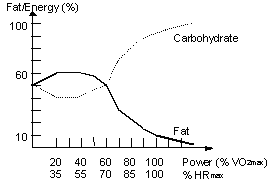
Figure 1. Energy sources during exercise
In the Physical
Activity and Health, a report of the Surgeon General (USA, 1996) it is stated
that activity leading to an increase in the daily expenditure of approximately
150 kcal/day, equivalent to about 1000 kcal/week, is associated with
substantial health benefits. It is also stated that the activity for health
benefits needs not to be vigorous.
For weight loss purposes the
recommended energy expenditure can be set to 300 kcal/session. Conducted on
most days of the week this will result 2000 kcal/week on a 70 kg person,
approximately the kilocalorie content of a 1 kg (or 2 pounds) fat (7000 kcal)
in a month. The higher the exercise intensity, the higher the heart rate, and
the faster the calorie expenditure. However, at high exercise intensities the
percentage of fat consumption of the total energy expenditure is less than at
lower intensities. Figure 2. presents comparison between the distribution of
energy sources in jogging and walking sessions.
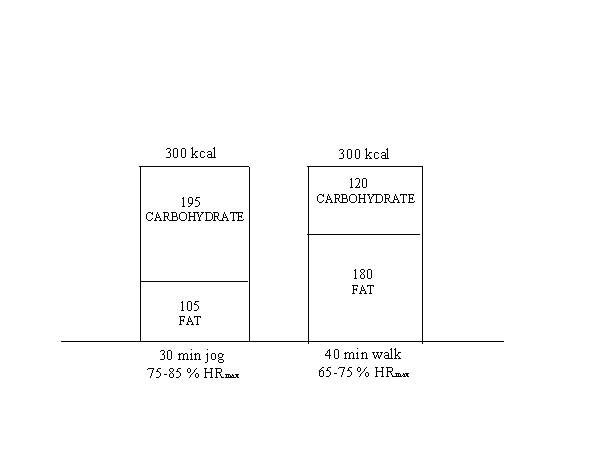
Figure 2. Comparison between the distribution of energy sources
in jogging and walking
Reference: U.S. Department of Health and
Human Services. Physical Activity and Health:
A Report of the Surgeon
General. Atlanta, GA: U.S. Department of Health and Human Services, Centers for
Disease Control and Prevention, National Center for Chronic Disease Prevention
and Health Promotion, 1996, p. 147.
Additional reading:
Kukkonen-Harjula K, Laukkanen R. Precision weight management. Polar Electro Oy.
Third Edition in English, 1998. |
 Fuel Your Body
 Get Fitter
 Get Stronger
 Then Go For It