|
Learning to
Read Food Labels
From
BODi
Fitness & Health
Low fat! Sugar free! Low carb! Reduced fat! What
does it all mean?
With the millions of claims on
your grocer's shelf, you'd think we live in a wonderland of healthy, guilt-free
foods. Fat-free chocolate frozen yogurt sounds yummy. Why not? It's good for
you, right?
Wrong. Fat free doesn't mean
healthy. And it sure doesn't mean sugar free. Odds are, your creamy, supposedly
healthy, miracle food is loaded with sugar.
But how are you supposed to know
that? The label says it's fat free! How can they manipulate you like that?
Aren't there laws keeping food manufacturers on the up-and-up?
Well, yes, there are, but
manufacturers are spin masters. Much like tabloid headlines, food packaging
isn't designed to inform; it's designed to distort the truth so you'll pick it
up. However, where tabloids can continue the charade page after page, once you
turn over food packaging, the distortion comes to an abrupt halt. Behold your
secret weapon against dodging food manufacturers—the Nutrition Facts
box.
|
|
Serving Size 34g
Servings per package 15 |
|
| Amount Per
Serving |
|
| Calories |
160.0000 |
|
Calories from Fat |
60.0000 |
|
|
| % Daily
Value* |
|
| Total Fat 7.0000g |
|
11 % |
|
|
| Saturated Fat
1.5000g |
|
7 % |
|
| Cholesterol 0mg |
|
0 % |
|
|
| Sodium 210.0000mg |
|
9 % |
|
|
| Total Carbohydrate 24.0000g |
|
8 % |
|
|
| Dietary Fiber
1.0000g |
|
4 % |
|
|
| Sugars 13.0000g |
|
|
|
| Protein 2.0000g |
|
|
|
|
| Amount Per
Serving |
|
| Calories |
160.0000 |
|
Calories from Fat |
60.0000 |
|
|
|
| % Daily
Value* |
|
| Vitamin A 0% |
|
Vitamin C 0% |
| Calcium 0% |
|
Iron 8% |
|
|
|
|
|
To learn a little more about the
box, let's have a look-see at that perennial favorite, the Oreo cookie. The
first thing we'll look at is the serving size: 3 cookies. Sounds good. I don't
know a lot of Oreo eaters who stop at three, but now we know that everything we
read on this chart is based on three cookies.
Sometimes, a company can get a
little sneaky with this—case in point, the "serving size" of a 20-ounce
bottle of Coke. If you look at the nutritional facts, you discover that they're
meant for an 8-ounce serving. That is to say, one bottle is intended to be
split between two and a half people. Nobody does this, in part because half
people aren't generally interested in soft drinks. A superficial read of the
label leaves you thinking you're drinking 100 calories when, in fact, you're
quaffing 250 calories of High-Fructose Corn Syrup.
But I digress. Back to the
Oreos. Your three cookies are 160 calories. Of this 160, around 60 are fat, 94
are carbohydrates, and 2 are protein. Those of you into math may notice these
numbers don't follow the exact calculation of multiplying the grams into
calories. That's because within reason, companies can round these numbers off,
but now we're splitting hairs.
Let's start by looking at the
fat. Just what kind of fat are we going to find? For that, we'll skip down a
line.
There are four kinds of fat:
saturated, trans, polyunsaturated, and monounsaturated. As you probably know,
the first two are bad and the last two are good. Currently, the FDA requires
that only saturated fat be listed, so we see that of the 7g of fat, 1.5g are
saturated. But hold on, what about the remaining 5.5g? Is it happy unsaturated
fat or evil processed trans fat? Fortunately, as of January 1, 2006, food
manufacturers will be required to list trans fat as well, but until then, we're
forced to pop down to the listed ingredients and do a little guesswork.
Ingredients are listed in
amounts, from most to least, so here we see Oreos are, surprisingly, made
primarily of sugar. Bad, sure, but not a source of fat. Next comes enriched
flour. Also bad, but also not fat. Next comes partially hydrogenated soybean
oil. Bingo—there's your fat right there—and evil trans fat, in fact,
so it's safe to assume that some of that unaccounted-for 5.5g is trans fat.
(The actual number, FYI, is 2.5g of trans fat.)
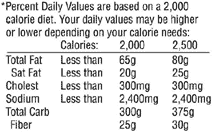
To the right of all these
numbers, you'll notice more numbers with percentage signs next to them. This is
the percentage of the amount of that nutrient you should be getting daily,
based a 2,000-calorie diet. It's probably the most complicated part of the box.
First off, not everyone eats 2,000 calories a day. So if you eat more, or less,
you'll have to do a little math.
Secondly, for the total fat,
saturated fat, cholesterol, and sodium percentages, you should be eating that
or less than that. (That said, our suggestion is to treat the total fat
and sodium percentages as a number you target, not consume less than.) For
total carbohydrates, you should be having that more-or-less exactly.
For all the vitamins and
minerals and dietary fiber, you should be having at least that much.
You'll also notice that some
labels include additional information. The FDA requires that all food labels
list total calories, calories from fat, total fat, saturated fat, cholesterol,
sodium, total carbohydrate, dietary fiber, sugars, protein, vitamin A, vitamin
C, calcium, and iron. However, there are a host of other nutrients that the
food manufacturer can opt to list, such as polyunsaturated fat, potassium,
soluble fiber, insoluble fiber, sugar alcohol, and other essential vitamins and
minerals. Odd, you say? I thought so, too.
Our next stop is cholesterol.
There are plenty of claims out there that eating good cholesterol will lower
our bad cholesterol. These are largely unproven. Evidence may, in time, become
more concrete, but for now, avoiding any cholesterol is the best course of
action. The body makes all the good cholesterol you need without you trying to
add more. Oreos have no cholesterol.
After that is sodium. As we
suggested above, you need sodium, especially if you're on a sweaty, difficult
exercise program, so try to treat this as an amount to aim for. That said, very
few people need to actively seek out sodium. Just eat a balanced diet and it
will find you. Our three cookies have 210mg of sodium, or 9% of the recommended
daily allowance.
Next come carbs. This is a
somewhat vague section of the Nutrition Facts box. While listing total
carbohydrates, dietary fiber, and sugars is mandatory, listing sugar alcohol
and complex carbs is not. In fact, there is no listing for complex carbs, only
the mysterious heading "other carbohydrates." It's a rare label indeed that
really spells out a food's carbohydrate breakdown.
Although our Oreos have no sugar
alcohol, let's discuss the stuff for a minute. Sugar alcohol is naturally
occurring in the body and, at this writing, its only real problem is the
occasional gastrointestinal difficulty. If the box doesn't specifically list
sugar alcohols, you can look for them in the ingredients—they usually have
the suffix "-itol."
Keep in mind that sugar alcohol
isn't, as often advertised, guilt-free sweetness. While other carbohydrates
have 4 calories to the gram, sugar alcohol still has about 1.5 or 2 calories
per gram. The rest is made of indigestible matter, hence the reason for gastric
problems.
Looking at our Oreos, we don't
see any "-itol" ingredients. However, the second ingredient is enriched flour,
so it's safe to assume that the unaccounted-for 10g of carbohydrates are
complex.
One neat thing you can do in the
carb part of the Nutrition Facts box is determine if a food will cause a sugar
spike. Although protein and fat slow sugar absorption, fiber does the best job,
so if your fiber's high, you're in better shape. Oreos have 1g of fiber, so it
looks like spike city.
Finally, protein. Our Oreos have
2g of protein. Unfortunately, the box doesn't list whether this is a complete
protein or not, so you'll have to look at the ingredients and bone up on
protein sources. The last ingredient in our Oreos is whey, so some of that
protein is probably complete, albeit there's not enough to add to your
nutritional profile for the day.
After this, the box goes into
vitamins and minerals. Oreos don't have much, save a little iron from the
enriched flour.
See? Labels are not all that
tough. Now you're empowered. They can throw all the claims at you they want,
but you're not going to fall for them because you're now a label reader!
|
|
 Fuel Your Body
 Get Fitter
 Get Stronger
 Then Go For It