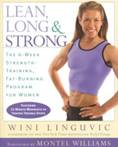
Lean, Long & Strong:
from Wini Linguvic By Wini Linguvic - author of
Lean, Long & Strong: The 6-Week Strength-Training,
Fat-Burning Program for Women
 If you want to get more exact
with your precision cardio, you can use a heart rate monitor in addition to
evaluating your rate of perceived exertion. The heart rate monitor will tell
you exactly what your heart rate is as you're exercising, which means you can
then increase or decrease your intensity to get a precise workout. If you want to get more exact
with your precision cardio, you can use a heart rate monitor in addition to
evaluating your rate of perceived exertion. The heart rate monitor will tell
you exactly what your heart rate is as you're exercising, which means you can
then increase or decrease your intensity to get a precise workout.
First, you'll need to figure out the heart rate range that you should be
working at. The best way to do this is to get tested by an exercise
physiologist. If you don't want to do that, you can get a pretty good estimate
by calculating your maximum heart rate and then calculating certain percentages
of this rate to work at for your warm up and cool down, your moderate pace, and
your interval pace. This will be a good starting point, though keep in mind
that this calculation is based on the "average" person -- something that none
of us is!
To estimate your maximum heart rate, subtract your age
from 226. (Men would subtract their age from 220.)
226 - your age = age-adjusted maximum heart rate
Now, take your age-adjusted maximum heart rate
and calculate the following percentages for the various parts of your workout.
·
60 percent for your warmup and cooldown
·
65 to 75 percent for your moderate pace
·
75 to 85 percent for your vigorous or interval pace
For instance, a 40-year-old woman's estimated maximum
heart rate is 186 (226 - 40 = 186).
·
60 percent of her max = 112
·
65 percent of her max = 121
- 75 percent of her max =
140
- 85 percent of her max =
158
Keep in mind, however, that this calculation can be off by as much as
15 beats, so use the rate of perceived exertion as well. Also take into account
that your heart rate can vary depending on which activity you choose. Different
activities use different skills and muscle groups, so an experienced swimmer
will have a lower heart rate swimming than she does when running. Keep that in
mind as you vary your cardio choices. Also, some exercises that you do while
sitting down, like riding a recumbent bicycle, won't get your heart rate as
high as those that you do while standing, such as walking hills outside. So use
your heart rate monitor and evaluate your rate of perceived exertion, but also
learn to listen to your body.
Reprinted from:
Lean, Long & Strong: The 6-Week Strength-Training,
Fat-Burning Program for Women By Wini Linguvic © 2005
Wini Linguvic. Permission granted by Rodale, Inc., Emmaus, PA 18098
Author
Wini Linguvic is one of New York
City's most sought-after personal trainers and fitness consultants. A certified
fitness instructor and trainer for more than two decades, she is coauthor of
the New York Times best-selling book BodyChange, which she wrote with longtime client and friend
Montel Williams.
For more information, please visit the author's Web
site at www.leanlongandstrong.com.
|
 Fuel Your Body
 Get Fitter
 Get Stronger
 Then Go For It