Heart
Rate Monitoring And Swimming
With A Heart Rate Monitor
by
Kathy Kent -
Heart Zones Training and Education
Company
Talk to
the swimmer in the lane next to you sometime and ask them what their heart rate
is when they’re swimming. Chances are, they have no idea. Why? The next time
your coach says to swim the following set of 50s hard, do you ask, How
hard?. The next time the coach says to swim the next set of 100s at
80% effort, exactly how hard is that?
What is 80%, 90%, or even 100% effort for that
matter? 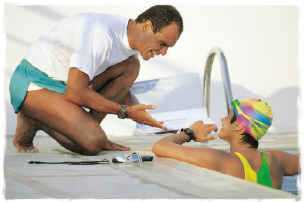 These are all excellent questions to ask both yourself and your
coach next time you hop in the pool.
Heart rate monitoring has been a very successful measure of effort or
exertion for a very long time.
Why, then, arent swimmers using their heart rate monitors? Lets look at the following
reasons: These are all excellent questions to ask both yourself and your
coach next time you hop in the pool.
Heart rate monitoring has been a very successful measure of effort or
exertion for a very long time.
Why, then, arent swimmers using their heart rate monitors? Lets look at the following
reasons:
-
Myth: Heart rate
monitors are too expensive.
Truth: Heart rate monitors can be purchased for as little as
$50.00.
-
Myth: Heart rate
monitors are not waterproof.
Truth: Almost all heart rate monitors are waterproof, with the
following recommendation: do not
press the buttons underwater as this may break the waterproof seal.
-
Myth: Heart rate
monitors are too hard to program and understand.
Truth: Sure, some instructions can be as confusing as programming
your VCR, but you read it once or twice until you finally get it.
-
Myth: Heart rate
monitors are difficult to wear and use.
Truth: With the information available these days, all it takes is
either a few minutes on the internet, or a few hours with a good book to
understand how to read the results of your heart rate monitor and plan an
exercise or training program accordingly.
-
Myth: Heart rate
monitors give inaccurate information in the water.
Truth: To this we can only assume that the monitor is being worn
incorrectly or the battery needs to be replaced. Occasionally, a monitor may shift in the water losing
contact with the chest (or back).
In this instance, give the monitor an extra few seconds to record
data.
Heart Zone Training is a concept
developed by Sally Edwards, author of
The
Heart Rate Monitor Book, which is used by world-class athletes (and fitness
enthusiasts) around the world. Heart Zone Training applies predetermined zones to applied
principles of training. Refer to
the attached chart. The following
are very basic principles of training.
Ones training can be taken to an elite level using the following
principles and using a heart rate monitor to measure
workouts.
-
An
athlete should spend approximately 60% of the week’s total workout in an
aerobic zone (zone 2 and zone 3).
-
An
athlete should spend approximately 25-30% of the week’s total workout
developing the anaerobic system (zone 4).
-
An
athlete should spend only 10-15% of the week’s total workout in the
“redline” zone (zone 5) which develops speed.
-
An
athlete should allow 48 hours between workouts in the redline
zone.
All of the above principles of training
should be applied seasonally as well to provide for maximum benefits. For instance, the early season might consist 100% of aerobic
work, building an endurance base.
As the base is built, anaerobic threshold work can be added. These workouts are done at 80-90% of
maximum heart rate. The purpose of
these workouts is to adapt the body to increasingly more difficult
workouts. Eventually, time in the
anaerobic zone will become a comfortable place to be as the anaerobic threshold
moves closer to ones maximum heart rate.
Finally, time spent in zone 5 should be added as the race season
nears. Zone 5 is speed
training. Because of the
difficulty sustaining 90-100% maximum heart rate, time spent in zone 5 is
limited to just a few minutes with a longer recovery period
required.
Have you encountered
the swimmer who always swims at the same speed? Perhaps you know the swimmer who does
everything hard everyday? Maybe
you know the opposite swimmer, one who swims everything too easy. Actually, most athletes fit into one of
these two categories: they either
train too hard all the time or too slow all the time.
Proper scheduling of workouts can further increase the athletes
benefit. For instance, it is an
inefficient use of time to do a zone 5 workout when fatigued by the previous
days workout. Proper recovery is
essential if the athlete is to truly work through zone 5. Additionally, an easy aerobic workout
should follow a zone 5 workout.
This not only aids in improving performance in zone 5, but also allows
for proper recovery and helps prevent unnecessary injury and/or illness from
over training.
BUT I DON’T KNOW
MY MAXIMUM HEART RATE!
No
problem! But, you need to do a
test or two knowing the following:
1.
For maximum accuracy, perform a swim max test, which will take you to
complete exhaustion (you will feel like puking, if youve done it
right).
2.
Your maximum heart rate on land (either running or cycling) is the point
at which increased effort does not result in an increase in heart rate for one
minute.
3.
Only as a last resort, use this preferred formula:
210 - (.5 x age) (.05 x body weight) +
4 (men only) = maximum heart rate
This formula assumes that fitness declines
with age (not necessarily true).
4.
Your maximum heart rate in the water may be 10-15 beats lower than
your heart rate on land due to the
cooling effect of the water, buoyancy, gravity, etc
Some
individuals should consult a doctor before taking a maximum heart rate
test. There are a few good
sub-maximum tests available. Good
luck in your training! |
 Fuel Your Body
 Get Fitter
 Get Stronger
 Then Go For It