Skin Facts - Test Your Skin
IQ By Monica Gomez
From
BODi Fitness &
Health
Your skin is the largest organ in your body
and your first line of defense, so it is good to know the facts about your
skin. Here are some skin facts that you might not know.
 False: Toothpaste effectively
treats acne. Toothpastes contain sodium monofluorophosphateor, plainly
put, some chemical form of fluoride. While fluoride helps protect your teeth
against tooth decay and works with saliva to protect tooth enamel from plaque
and sugar, it can be slightly less helpful to your skin. Fluoride can actually
irritate or burn the skin as well as provoke skin allergies. It's true that
other ingredients in toothpaste, like hydrated silica, sorbitol, alumina, and
glycerin, may have the potential to combat acne. In fact, silica and types of
aluminum are used to treat acne via dermabrasive products. However, in
toothpaste, these ingredients are too minimal to make an effective impact or to
profoundly exfoliate the skin. Yes, the placebo effect may be hard to argue
with, but keep in mind that toothpaste is designed to protect your teeth, not
your skin. False: Toothpaste effectively
treats acne. Toothpastes contain sodium monofluorophosphateor, plainly
put, some chemical form of fluoride. While fluoride helps protect your teeth
against tooth decay and works with saliva to protect tooth enamel from plaque
and sugar, it can be slightly less helpful to your skin. Fluoride can actually
irritate or burn the skin as well as provoke skin allergies. It's true that
other ingredients in toothpaste, like hydrated silica, sorbitol, alumina, and
glycerin, may have the potential to combat acne. In fact, silica and types of
aluminum are used to treat acne via dermabrasive products. However, in
toothpaste, these ingredients are too minimal to make an effective impact or to
profoundly exfoliate the skin. Yes, the placebo effect may be hard to argue
with, but keep in mind that toothpaste is designed to protect your teeth, not
your skin.
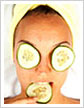 True: Cucumbers do not
contain inherent properties that combat under-eye puffiness. Freshly
cut, cool cucumber slices are commonly used to reduce under-eye puffiness.
Although it is believed that cucumber flesh can reduce swelling and revitalize
skin, or that some inherent property in the cucumber is responsible for this,
cucumber is over 90 percent water and the remainder is mostly inert fiber that
provides no benefits for your skin. So what it is about cucumbers that make
them effective for treating the tired-eye look? The reason behind that is their
cool temperature. You store cucumbers in your refrigeratorhence their cool
temperature. The cold temperature is what is responsible for reducing the
swelling under your eyes (by constricting blood vessels and reducing the inflow
of fluid into soft tissues). The same results can be obtained with a washcloth
dipped in cold water. True: Cucumbers do not
contain inherent properties that combat under-eye puffiness. Freshly
cut, cool cucumber slices are commonly used to reduce under-eye puffiness.
Although it is believed that cucumber flesh can reduce swelling and revitalize
skin, or that some inherent property in the cucumber is responsible for this,
cucumber is over 90 percent water and the remainder is mostly inert fiber that
provides no benefits for your skin. So what it is about cucumbers that make
them effective for treating the tired-eye look? The reason behind that is their
cool temperature. You store cucumbers in your refrigeratorhence their cool
temperature. The cold temperature is what is responsible for reducing the
swelling under your eyes (by constricting blood vessels and reducing the inflow
of fluid into soft tissues). The same results can be obtained with a washcloth
dipped in cold water.
 False: SPF 30 sunscreen is
20 percent more effective than SPF 15 sunscreen. Actually, SPF 30
sunscreen is only 2 percent more effective than SPF 15 sunscreen. The stronger
"dosage" or SPF doesn't necessarily afford you more time in the sun. SPF
15-rated products block approximately 94 percent of UV rays while SPF-30 rated
products block about 96 percent of UV rays (SPF 40-rated products block around
97 percent). The difference is minimal. What is important is that you use
products that are at least an SPF-15 and are "broad-spectrum," which
means that they'll protect your skin against UVB and UVA rays (for more on the
effects of these rays, read Steve's article above). Look for the ingredient
Parsol 1789 (avobenzone) for solid coverage. It is recommended that you apply
sunscreen 15 to 30 minutes before exposure and that you reapply every 2
hoursregardless of whether or not you've gotten wet. False: SPF 30 sunscreen is
20 percent more effective than SPF 15 sunscreen. Actually, SPF 30
sunscreen is only 2 percent more effective than SPF 15 sunscreen. The stronger
"dosage" or SPF doesn't necessarily afford you more time in the sun. SPF
15-rated products block approximately 94 percent of UV rays while SPF-30 rated
products block about 96 percent of UV rays (SPF 40-rated products block around
97 percent). The difference is minimal. What is important is that you use
products that are at least an SPF-15 and are "broad-spectrum," which
means that they'll protect your skin against UVB and UVA rays (for more on the
effects of these rays, read Steve's article above). Look for the ingredient
Parsol 1789 (avobenzone) for solid coverage. It is recommended that you apply
sunscreen 15 to 30 minutes before exposure and that you reapply every 2
hoursregardless of whether or not you've gotten wet.
 False: Cellulite only affects
overweight women and men. Cellulite can affect any woman,
regardless of weight, and it is also a problem that a fewer number of men
experience. Cellulite is a form of fat malformed, trapped fat located in the
first subcutaneous layer of the skin. Unfortunately, it is highly resistant to
exercise and dieting. This resistant nature is due to how cellulite fat is
trapped (it's trapped in a mesh of fibrous connective tissue). Also, it's not
just limited to the thighs and buttocks; cellulite can occur in the upper arms,
the back of the neck, and the stomach. While there is no known "cure" for
cellulite, methods to combat this stubborn condition range from expensive
creams to deep mechanical massages. False: Cellulite only affects
overweight women and men. Cellulite can affect any woman,
regardless of weight, and it is also a problem that a fewer number of men
experience. Cellulite is a form of fat malformed, trapped fat located in the
first subcutaneous layer of the skin. Unfortunately, it is highly resistant to
exercise and dieting. This resistant nature is due to how cellulite fat is
trapped (it's trapped in a mesh of fibrous connective tissue). Also, it's not
just limited to the thighs and buttocks; cellulite can occur in the upper arms,
the back of the neck, and the stomach. While there is no known "cure" for
cellulite, methods to combat this stubborn condition range from expensive
creams to deep mechanical massages.
 True: Twenty minutes of exposure to a tanning bed is
equivalent to spending 4 hours in the sun. Tanning beds may increase
your risk of skin cancer. That's because they give out UVA rays, "which
penetrate deeper into the skin [than UVB rays], accelerating aging and causing
skin cancer" (refer to Steve's article for more on this). UVA rays are also
know to weaken the immune system. It is a misconception that a tan is healthy
and that it protects you from sunburn. A tan on a light-complected person acts
only as an SPF 4 sunscreen, approximately. A tan is actually the result of the
body defending itself against further damage from UV radiation. And sunburns
will increase the risk of skin cancer, wrinkles, freckles, and leathery skin
later in life. True: Twenty minutes of exposure to a tanning bed is
equivalent to spending 4 hours in the sun. Tanning beds may increase
your risk of skin cancer. That's because they give out UVA rays, "which
penetrate deeper into the skin [than UVB rays], accelerating aging and causing
skin cancer" (refer to Steve's article for more on this). UVA rays are also
know to weaken the immune system. It is a misconception that a tan is healthy
and that it protects you from sunburn. A tan on a light-complected person acts
only as an SPF 4 sunscreen, approximately. A tan is actually the result of the
body defending itself against further damage from UV radiation. And sunburns
will increase the risk of skin cancer, wrinkles, freckles, and leathery skin
later in life.
|
|